 Aircraft modifications may look simple from the outside, but every interior upgrade or structural change follows a tightly controlled, highly regulated process. Engineering, compliance, and production work closely together to turn designs into certified, airworthy solutions.
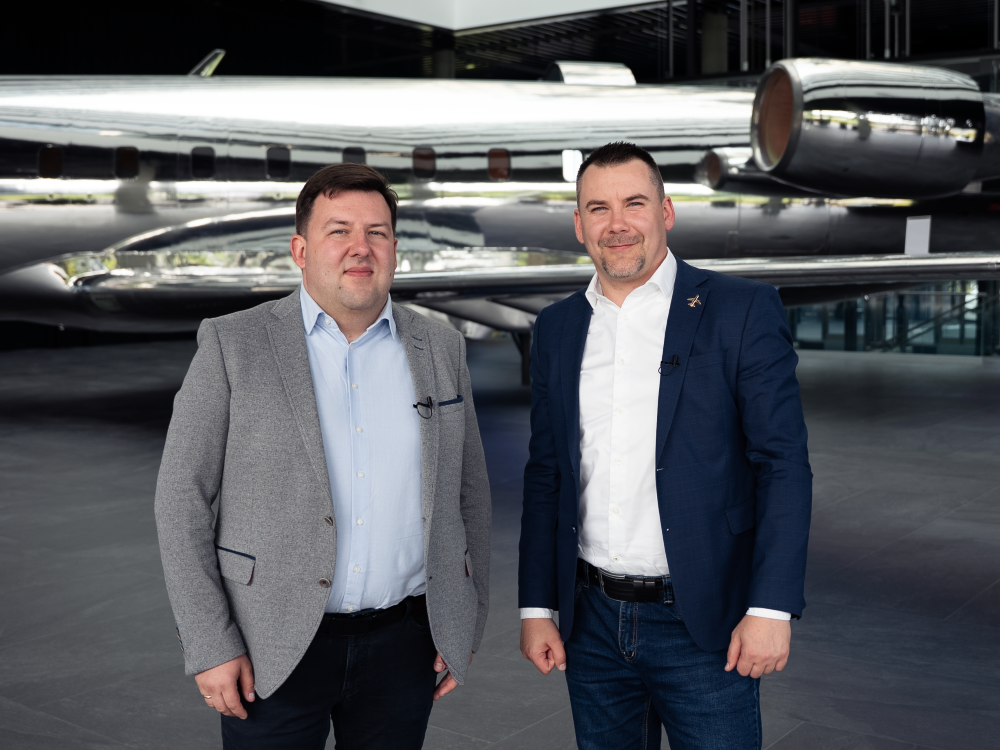
Donaldas Barkauskas, Head of Design & Production, and Pavel Olenskij, Head of Airworthiness, oversee how their Design Organisation Approval (DOA) and Production Organisation Approval (POA) teams manage these processes.
How design and production work together
In aviation, interior design and production are not separate field. At FL Technics, they operate as a single, certified end product.
“The Design Office develops the engineering solution – whether it’s a small interior modification or a more complex aircraft refurbishment – and prepares the full technical documentation package,” explains Pavel Olenskij. “Once this phase is complete, production manufactures the part itself. The customer receives not only the physical component but also a single installation document that clearly explains how that part must be installed on the aircraft.”
This integrated DOA–POA cooperation simplifies the process for operators, leasing companies, and ACMI providers. Instead of coordinating multiple suppliers, customers receive a complete, compliant solution – from concept to installation – delivered under one roof.
Evaluating customer requests
Aircraft operators naturally want solutions tailored to their operational and commercial needs. However, not every idea can be safely or legally implemented.
“A customer comes with their needs, and that’s completely natural,” says Donaldas Barkauskas. “Airlines usually work with a small number of trusted design organizations. Their engineers come to us to discuss their ideas and check whether those ideas can realistically be materialized on the aircraft.”
Meeting safety and regulatory requirements
Compliance with safety and regulatory requirements is non-negotiable in aviation. But many operators go further.
“Regulations differ between regions, such as Europe and the United States,” Pavel notes. “Some aircraft owners and operators prepare in advance for potential transitions between jurisdictions. That forward planning saves both time and money later.”
Above regulatory alignment, there is another group of customers focused on high-value, creative solutions. “These operators invest in solutions that improve the working environment for crews and create a better experience for passengers,” Pavel continues. “Compliance keeps you safe. Smart choices create value. The real advantage comes from combining both.”
Choosing the right DOA or POA partner
Choosing a DOA or POA partner isn’t about finding a “one-size-fits-all” organization. Only a limited number of design and production organizations can handle a broad range of aircraft modifications, which is why FL Technics combines its certified capabilities with a trusted partner network to deliver end-to-end solutions.
“Operators don’t want requests rejected – they want a partner who can take care of all requested work scope,” says Donaldas Barkauskas. “We work with trusted partners for different scopes and processes, so when a customer comes to us, they know we can manage the entire project quickly and reliably. For airlines, leasing companies, or ACMI providers, having one partner who can solve all the headaches is essential.”
Understanding client expectations and being upfront about what’s possible saves time, reduces costs, and accelerates delivery – all without compromising safety or compliance. The real advantage lies in choosing a partner who doesn’t just say “yes,” but one who says, “we know how to get it done.”
Will AI reshape aircraft design and production?
Aviation design and production have always balanced two worlds: the technical and the managerial. AI already shows strong potential on the managerial side – from process optimization and workflow management to customer support and improving the passenger experience. When it comes to technical decisions, however, progress will inevitably be slower. Aviation remains a conservative, heavily regulated industry, and every new technology must pass rigorous oversight before it can be applied to an aircraft.
That said, major industry players are steadily moving toward AI adoption. While these early steps may seem modest, they point to a future where design, production, and aircraft engineering become more efficient, more data-driven, and increasingly optimized – without compromising safety or compliance.
From design to certification
Aircraft design and production demand forward-looking engineering, regulatory awareness, and disciplined execution. Success in this field depends on more than technical capability alone. It requires open communication with customers, honest evaluation of feasibility, deep regulatory expertise, and seamless cooperation between design and production teams. By combining all these elements, FL Technics ensures every approved idea – from a minor interior update to a major modification – reaches the aircraft as a safe, certified, and fully documented solution.