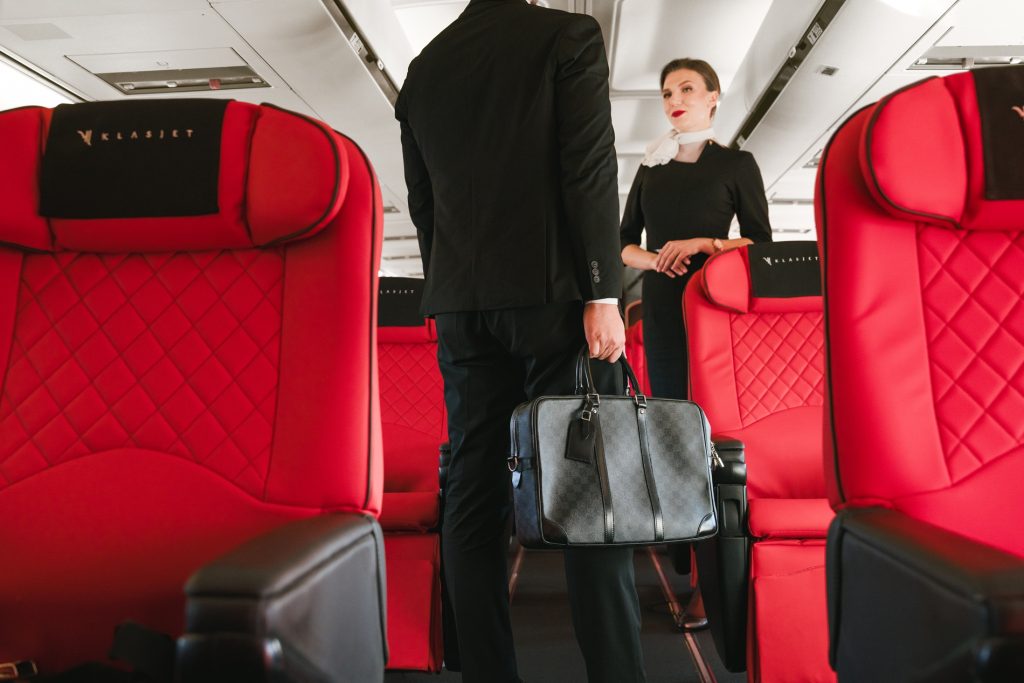
 In an increasingly turbulent aviation landscape where delays, cancellation, strikes, and airport congestion are becoming worryingly familiar, private and charter aviation offer a more dependable alternative. Marton Modis, Chief Commercial Officer for VIP operations at premium VIP charter and ACMI provider KlasJet, shares an insider view on the changing business travel environment.
The European airline industry is facing a convergence of pressures with few precedents. The closure of the Strait of Hormuz has pushed jet fuel prices to $150–200 per barrel, prompting carriers such as Lufthansa to cut tens of thousands of short-haul flights. Unresolved ATC strikes across France, Spain and Italy are compounding the disruption, while Eurocontrol data shows these three countries already account for two-thirds of all en-route flow management delays. The result is a commercial aviation network under sustained, structural pressure — and you have the perfect storm.
Uncertainty cuts both ways
The natural assumption may be that this level of instability in commercial air travel would lead to a rise in charter travel, but the picture is far more nuanced than that. As Marton Modis, Chief Commercial Officer for VIP operations at KlasJet, explains:
“The current political landscape has affected aviation massively. All of this has created a ton of uncertainty: airlines are reducing routes, passengers are more hesitant to spend big on travel. For us, it has created an even bigger divide – clients who fly with us regularly are now more reliant on us than ever, but those for whom chartering is not business-critical are being very cautious.”
Although there was an uptick in enquiries after the initial wave of disruptions, the situation has now stabilised, and volume is roughly in line with 2025. Modis, however, is quick to strike a note of caution. “This year is a little out of balance, born out of the uncertainty in the market.”
Who feels it most
Nonetheless, from this challenging and complex picture a new client segment is emerging for the charter industry: organisations and individuals who had hitherto relied on commercial aviation for their business critical travel.
“Corporate delegations, sports teams, government clients and family offices who mostly stayed away from chartering are now facing a choice: cancel – which is not always feasible – or increase budgets and choose charter. We work with these clients to limit their financial exposure while building long-term relationships, in the hope they will still come back to chartering even when the commercial aviation industry recovers.”
This new segment brings with it a new suite of requests, Modis continues.
“We’re seeing last minute schedule recoveries, where a group needs to get airborne after their commercial connection has collapsed. This kind of request drove demand early in the year. But now that businesses are becoming more aware of the surrounding structural pressures, they’ve started planning ahead. And this means they are placing more emphasis on having a reliable partner.”
Risk management, not luxury
This expansion in client base reflects a broader redefinition of the notion of luxury, as Modis is quick to emphasize:
“Luxury is today defined less by sparkle and gold than it is by convenience, speed, comfort and agility. Our job is to highlight that while our service is rooted in traditional luxury values, our operations are designed to serve these more modern definitions. For clients weighing the cost of a charter against the cost of a missed connection, the conversation isn’t really about price or glitter – it’s about risk management.”
The charter model offered by operators such as KlasJet is one that is engineered for unpredictability. Whenever needed, the client’s booking can come with A, B and C plan options to ensure that eventualities are covered. The team monitors each flight in real time, with schedule changes being made proactively, before the client even is aware of any issues. As Modis illustrates:
“If an airport announces a strike from 12 UTC, we make sure to depart beforehand, communicating with the client at every step. Flexibility and communication are key – no surprises.”
Looking ahead
With ATC strikes so far unresolved in Spain and France, a Lufthansa pilot workforce holding a near-unanimous strike mandate, and the Strait of Hormuz showing no imminent resolution, the pressure on commercial aviation is unlikely to ease before peak season begins. KlasJet’s June–September schedule is already full – long-lead bookings alongside same-day requests – with the FIFA World Cup in the United States adding further weight to an already unpredictable year. For clients with fixed travel obligations, the window to secure capacity is narrowing.
“Chartering is already a major and critical element of business travel. We expect that this will be even more significant going forward – and KlasJet is ready to meet that demand.”